
Friday, September 18, 2026
New! Ticket Reports Have Arrived
We’ve expanded the new LibraryH3lp Analytics Reports page to include ticket reporting!
If you’ve already explored the recently upgraded chat reports, the ticket reports will feel familiar. You get the same interactive charts, flexible analysis controls, customizable visualizations, sortable tables, totals, and download options—but with filters and groupings designed specifically for our new tickets module.
Start with a built-in ticket report
You’ll find several new built-in reports under the Tickets section of the Analytics Reports sidebar:
- Tickets per day
- Tickets per month
- Tickets per queue
- Tickets per staff
Tickets per Day and Tickets per Month make it easy to compare when tickets are opened and closed, while the queue and staff reports help show how ticket activity is distributed across your service.
As with the chat reports, each built-in report is just a starting point. Click Report Settings and you can customize the report using Filter, Analyze, and Visualize controls.
Include opened tickets, closed tickets, or both
Ticket reporting introduces an important concept that doesn’t have an equivalent in chat reporting: ticket events.
You can report on:
- tickets that were opened during the selected date range
- tickets that were closed during the selected date range
- both opened and closed tickets
When both events are selected, charts can show them separately so you can compare ticket creation and closure activity over time.
For example, the Tickets per Day report shows opened and closed tickets across the days of the week, while Tickets per Month lets you compare the same activity by month.
For the closed event, only the final closed event is counted because, during its lifetime, a ticket may be closed and re-opened several times.
Filter by the current state of your tickets
In addition to choosing when a ticket was opened or closed, you can filter the results by the ticket’s current state.
Ticket filters include:
- Date range
- Ticket events
- Current ticket status
- Current queue
- Current assigned staff
- Current tags
Queue and staff filters can also use your existing folder organization, which is especially handy for larger services that organize departments, teams, or branches into folders.
Staff filtering includes "Unassigned", making it easy to find tickets that currently have no staff member assigned.
Tag filtering lets you focus reports on tickets carrying any of the selected tags.
Analyze ticket activity your way
The Analyze section controls what the report measures and how results are grouped.
Ticket reports currently measure ticket counts, which you can group by:
- Day of week
- Hour
- Month
- Year
- Queue
- Staff
You can combine groupings to answer more specific questions.
Want to see ticket volume by month and queue? Compare activity by day of week and staff member? Look at how opened tickets are distributed across queues? The Custom Report gives you room to build those views without being limited to the built-in presets.
Bar, line, and pie charts
Ticket reports support the same charting tools introduced with the new chat reports, including bar, line, and pie charts where appropriate.
Hover over chart data to inspect individual values. When a report contains multiple series, you can use the legend to temporarily hide or restore individual series.
The table beneath the chart provides another view of the same data, including useful row and grand totals.
Tables, totals, and downloads
Ticket report tables include the same improved table features available for chat reports, including sortable columns and more consistent totals.
Downloads are available too:
- Download the chart as an image
- Download the formatted table as CSV
- Download the underlying raw report data as CSV
The table-data download reflects what you see in the report, including labels, zero values, organization, and totals, while the raw-data option gives you the underlying results for your own analysis.
Updates to Open Tickets at a Glance
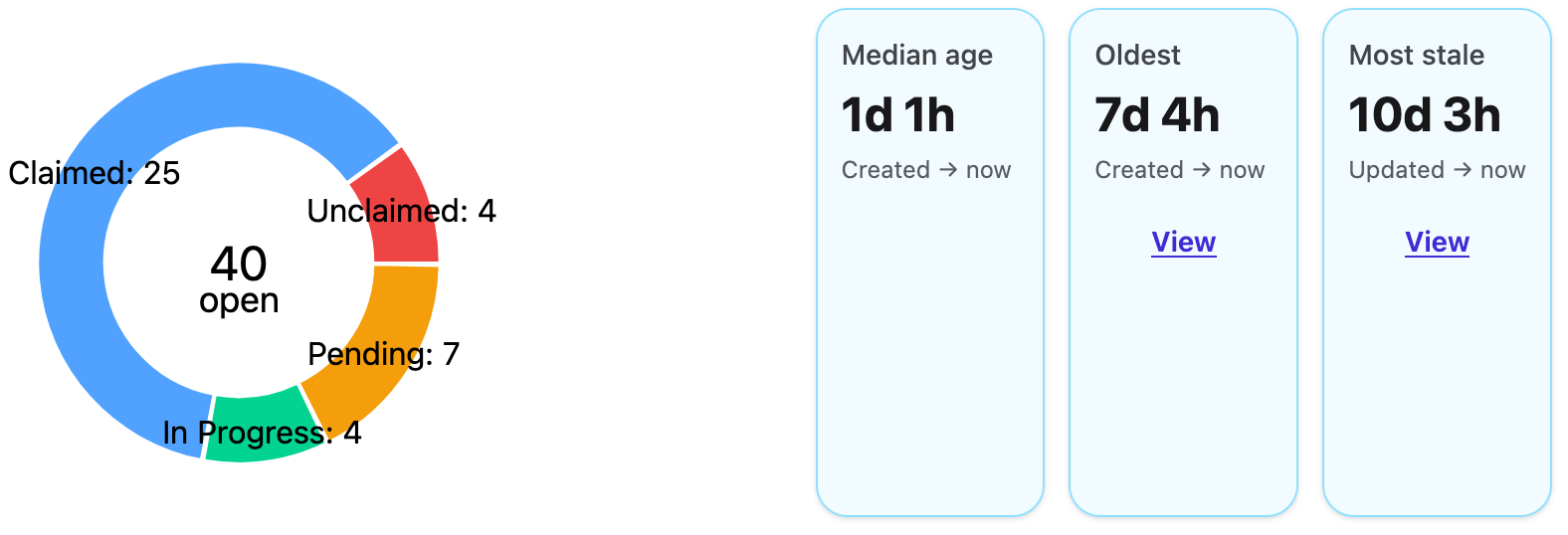
The "Open Tickets at a Glance" tab in the ticket management area is a great way to see what's happening now with your open tickets. These metrics remain unchanged from when we initially launched the Tickets module, but we have added the ability to download the charts as PNG image files and the underlying data in CSV format.

One of our favorite things about Tickets at a Glance is navigation directly to the actual tickets represented in a chart. In the chart pictured, selecting "Unclaimed" takes us directly to those 5 tickets, and we can note the active search has changed accordingly.
Explore!
Our goal with the new ticket reports is the same as with the redesigned chat reports: provide a useful set of built-in reports while giving you much more room to explore your own data.
Start with Tickets per Day, Tickets per Month, Tickets per Queue, or Tickets per Staff, then open Report Settings and experiment.
Or jump straight into Custom Report and build something from scratch.
We hope the new ticket reports help you get a clearer picture of how ticket activity moves through your service—and make it easier to answer the questions that matter to you.
Thursday, August 27, 2026
A New, More Powerful Reports Page
We’ve given the LibraryH3lp Reports page within the admin dashboard a major upgrade!
The new Reports page makes it easier to explore your chat activity and visualize trends, and answer questions about how your service is being used. You’ll still find familiar reports like Chats per Hour, Chats per Month, and Chats per Queue, but now these also serve as starting points for richer, more flexible reporting.
 |
| Chats per Hour |
Start with a report, then make it your own
The Reports page includes the familiar built-in reports for the chat module:
- Chats per hour
- Chats per month
- Chats per protocol
- Chats per queue
- Chats per operator
- Chats per profile
Choose one and you’ll get a chart and table of your data. From there, you can customize the report using Filters, Analysis, and Visualization settings.
Want to see chat counts by month and queue? Average wait time by operator? Activity by day of the week and hour? Want to lump a bunch of queues into one for a simpler report? The new Analysis controls let you choose what to measure, how to group the results, and which groups should appear as separate series on the chart.
More ways to visualize your data
Reports can now be displayed using bar, line, and pie charts, with the available visualization options depending on the report.
Charts are interactive, too. Hover over chart data to explore individual values, or use the legend to focus on the data you care about. Clicking a legend item hides that series from the chart; click it again to bring it back.
Charts and tables also work together. Hovering over data in one can highlight the corresponding data in the other, making it easier to connect individual values with the bigger picture.
 |
| Chats per Month: hover features |
New measures and calculations

A more useful table view
We've kept the powerful table features from the old reports and added row and grand totals more consistently. As mentioned above, hovering over table data highlights the corresponding data in the chart above.
And like in the original reports, you can click column headings to sort the results. Click again to reverse the order, and a third time to return to the report's original ordering.
 |
| Chats per Month: table close-up, reverse sorted by protocol |
Flexible report settings and an important default change
 |
| Report Settings |
We've also changed one important default: answered chats of any duration are now included in reports.
Previously, the default reports filter only counted answered chats that lasted at least 45 seconds. There's no longer a default minimum duration. If a minimum duration makes sense for the question you're asking, you can still set one yourself.
Reports still filter out unanswered chats by default, but you can include them if desired. Unanswered chats are those that never received a response from a chat operator.
Historical reporting also continues to include activity associated with users and queues that have since been deleted, so deleting something doesn't make its past activity disappear from your reports.
Download what you see—or get the raw data
You can download the chart as an image, and table downloads have gotten an upgrade as well.
If you want to take the nicely organized table into a spreadsheet, download the table data in CSV format. The data reflects the displayed table, including its organization, labels, zero values, and totals.
If you'd rather work with the underlying report results yourself, a raw data download is available too.
Explore!
The goal of the new Reports page is to provide a useful base set of reports that are similar to those provided in the prior version, while giving you room to explore further much more flexibly.
Start with one of the built-in reports, click Edit, and experiment with the Analysis options. Combining different measurements, groupings, and visualizations can reveal quite a bit about when your guests chat and how activity is distributed across your service.
We hope you'll have fun exploring your data with these new tools!
Wednesday, July 15, 2026
Introducing Guest Forms for Tickets, 3mail, and Chat
We're excited to introduce a powerful new feature in LibraryH3lp: Guest Forms. Guest Forms make it easy for guests to contact your organization, whether you're using Tickets, 3mail, or Chat.
One Form. Your workflow.
Every organization works a little differently. Some prefer a structured ticketing workflow. Others route inquiries through email. Some rely heavily on chat but need a way for guests to reach them when staff are unavailable. Guest Forms adapt to your workflow.When a guest submits a form, LibraryH3lp automatically delivers it where it needs to go:
Tickets → A new ticket is created with the submitted information.
3mail → An email is delivered to your shared mailbox containing the submitted information.
Chat → If your chat queue has an external email address set, an email is delivered to that external email address containing the submitted information.
The same form experience works across all three.
 |
| Screenshot of the Form Builder for Guest Forms |
Perfect for Offline Chat
One of our favorite uses for Guest Forms is pairing them with LibraryH3lp Chat.
When staff aren't available to chat, instead of telling guests that chat is offline and offering other ways to get in touch, you can present a Guest Form directly as your offline appearance. Guests can leave their question, provide their contact information, and continue with their day knowing someone will follow up.
It's a simple change that creates a smoother experience for the guest and helps to ensure that important questions don't get lost.
Whether you're using Tickets, 3mail, or an external organizational email address, Guest Form submissions make their way to the right destination seamlessly.
It's important to note that Guest Forms are all about guests contacting you outside the context of a chat. So if you are interested in Entry Forms for chat, where extra metadata is collected from guests just prior to the start of a chat, those can be configured separately in the Chat Skin Designer.
Built for the Real-World
Guest Forms include several important behind-the-scenes features.
Spam protection helps reduce unwanted submissions.
Support for custom fields lets each form collect the information that's most useful to your staff.
Optional submission metadata, such as referrer and IP address, can be captured when appropriate to aid troubleshooting and abuse prevention.
The same modern form experience works consistently regardless of whether submissions become tickets or email conversations.
We'd Love Your Feedback
We're excited to see how you use Guest Forms.
Whether you're managing help requests through Tickets, collecting messages with 3mail, or extending your Chat service beyond staffed hours, Guest Forms provide a flexible new way for guests to connect with your organization.
As always, we'd love to hear your feedback and learn how you're putting this new feature to work.
Monday, June 8, 2026
Introducing Tickets: A New Way to Manage Questions and Requests
We're excited to announce the release of Tickets, LibraryH3lp's new help desk module!
You already use Chat, 3mail, FAQs, and the Sharing Tool to connect with guests and provide great service. Tickets builds on these tools by helping you manage questions and requests that don't fit neatly into a live conversation.
Think of Tickets as your centralized place to track, organize, collaborate on, and resolve requests over time.
Why Tickets?
Chat is wonderful, but not every interaction happens in real time.
Sometimes a guest submits a question after hours. Sometimes a request requires research, follow-up, or coordination between departments. And sometimes you just need a better way to keep track of who is working on what.
A shared email box might not be quite enough if the guest's request is complex or if you have a big team.
That's where Tickets comes in. With Tickets, you can:
Track requests from start to finish
Keep guests informed through email notifications
Assign work to staff members
Organize requests with statuses and tags
Collaborate using staff-only notes
Transfer requests between departments
Instead of managing these interactions through a shared mailbox, Tickets gives you a dedicated workspace designed for ongoing support.
Multiple Ways to Create Tickets
Tickets can be created through:
Prefer structured intake forms? Use Guest Forms.
Want guests to simply send an email? Tickets can do that too.
Need to create a request on behalf of a guest? Create tickets directly from the Tickets interface. This is especially handy when the guest is on the phone or is in-person at a help desk.
Built for Teamwork
One of the biggest advantages of Tickets is collaboration.
Tickets can be assigned to staff members, reassigned when responsibilities change, and transferred between queues when another department is better suited to help.
Staff-only notes make it easy to share context internally without exposing those conversations to guests.
Whether your team consists of two people or multiple departments, Tickets helps keep everyone on the same page.
Familiar LibraryH3lp Concepts
If you're already using LibraryH3lp Chat, many parts of Tickets will feel familiar.
Like Chat queues, Tickets uses queues to organize expertise and route requests to the right people.
Need separate workflows for circulation, reference, technical services, archives, IT, or other departments? Create as many queues as you need. Tickets can be transferred between queues as needed.
Stay Informed
Tickets includes both email and visual notifications.
Staff can optionally receive emails when tickets are created, assigned, updated, or closed. Guests can receive emails throughout the lifecycle of a request, helping everyone stay informed without extra effort. Or you can set up email notifications to be more infrequent, only sent when specific events occur.
A Better Home for Complex Requests
Chat is great for immediate help. FAQs are great for self-service. Email helps teams communicate.
Tickets fills a different need.
It's designed for questions and requests that require tracking, follow-up, collaboration, or resolution over time.
Tickets won't replace every interaction. Chat remains the fastest way to provide immediate help, and FAQs remain a great self-service option for answers to standard questions. But when a request is more complex, Tickets gives your team a purpose-built way to manage it.
How Tickets Fits Into Your Subscription
The Tickets module is available in two ways:
Tickets Solo — for organizations that only need ticket management.
Core Plus One — for organizations that want to add Tickets to their existing LibraryH3lp Core subscription.
We've updated our pricing page so you can explore options and generate an instant estimate for your organization.
We're excited to see how libraries and other organizations use Tickets to streamline workflows, improve communication, and provide even better service.
The Tickets module is available now in LibraryH3lp. Curious? Check out our pricing page for details and an instant estimate, or email support and we'll be happy to set you up with a 30-day trial.
Thursday, October 2, 2025
Proactive texting from within the webclient for staffing
For quite a while now, we've offered proactive texting within 3mail. Now we're excited to announce that we're also offering the same feature directly within chat if you're using the webclient for staffing.
If you have opted to include the SMS add-on with your subscription, operators can hover over the texting queue in the webclient for staffing to find the "SEND SMS" button.
 |
| Hover over your queue in the webclient for staffing |
The "SEND SMS" button launches a window that asks for a phone number for the guest and a message.
 |
| Add a phone number for your guest and a message to send |
Finally, click "SEND" and you're all set. You'll see a chat with that guest appear. You can then close the chat window by clicking the X in the top, left corner or send additional messages if desired.
IMPORTANT for US customers: In order to comply with US regulations related to proactively initiating text messages to guests, you are required (if you haven't already) to email us information and supporting evidence which describes how guests will opt into receiving text messages from your organization. Typical SMS use that is already covered under your agreement with us is for responding to texts initiated by guests.
Don't have the add-on? Our text messaging add-on module is backed by Bandwidth and Twilio, two robust providers of SMS infrastructure for applications. With the add-on, you receive a standard 10-digit phone number or you can port an existing number into LibraryH3lp. Incoming text messages are handled like all other chats within the webclient interface and can be transferred, transcripts saved if desired, along with many other great features.
The add-on is available in the US and Canada. For countries outside the US and Canada, email us for availability. If texting sounds like something you might want to add to your subscription, let us know by email. We're happy to set you up with a no risk trial.
Monday, August 11, 2025
New! Wait time indicator for unanswered guest chats
We've added a handy new indicator to each guests's chat window that lets you know at a glance how long a guest has been waiting. The indicator appears at the bottom of chats when an operator has yet to answer.
.png) |
| Guest wait time indicator |
And no worries if you aren't a fan. You can turn the guest wait time indicator off within the webclient's preferences page. You'll find the setting for this under "Chat Window Settings."
.png) |
| Webclient Preferences -> Chat Window Settings |
Don't see this new feature? To make sure you have the latest version, please clear browser cache.
Monday, April 28, 2025
What (if any) impact have entry forms had on guest engagement?


.png)
